


Over the last couple years, something important changed in how people find and evaluate brands.
We started seeing it in client conversations before it showed up in headlines. Traffic dipped even while rankings stayed strong. Prospects arrived informed, decisive, and halfway through the buying process. In many cases, the shortlist was already made before anyone ever touched a website.
At the same time, AI interfaces began sitting between users and content. AI Overviews summarized entire categories. Chat tools replaced multiple searches with a single conversation. Communities and platforms became default research environments.
And just to be clear: this shift isn’t happening because Google is collapsing. Google is still 210x bigger than ChatGPT in search.
AI didn’t replace search. It changed how people move around it.
None of this made SEO irrelevant.
It made Google-only SEO incomplete and forced a broader digital marketing strategy built around how people actually discover brands today.
So no – we didn’t abandon SEO. We expanded it. We adjusted how we plan, how we measure success, and how we think about content to reflect how discovery actually works now.
Before we go any further, let’s clear the acronym clutter, because the internet has made this way more confusing than it needs to be:
- SEO – Search Engine Optimization
- AEO – Answer Engine Optimization
You’ll see all three floating around to describe what’s happening right now. Our take is simple: we don’t need new acronyms for an old discipline doing its job in new places.
It’s still SEO.
The scope just got bigger.
What changed wasn’t the fundamentals, it was where optimization shows up. Traditional SEO focused on ranking pages in search engines. Search Everywhere Optimization applies the same discipline to how content is summarized, referenced, and surfaced across AI systems and discovery platforms.

What Is Search Everywhere Optimization?
Search Everywhere Optimization is the practice of influencing audiences in all the places they consume information about a topic including search engines, LLM’s, and discovery platforms.
A few clarifications matter here:
- It’s still SEO. The acronym doesn’t change.
- It’s platform-agnostic and future-proof.
- It focuses on influence, not just traffic.
- It aligns with how modern discovery actually works.
This framing avoids unnecessary rebranding while accurately describing the expanded scope of the work.
SEO didn’t disappear.
It stopped being Google-only.
At a tactical level, the difference looks like this:
|
Traditional SEO |
GEO & AEO |
|
Optimize individual pages for target keywords |
Optimize topics and entities for full coverage |
|
Focus on rankings in Google SERPs (search engine results pages) |
Focus on visibility across search, AI, and discovery platforms |
|
Write content to win clicks |
Structure content to be summarized, cited, and referenced |
|
Measure success by traffic and rankings |
Measure success by influence, inclusion, and assisted conversions |
|
Optimize primarily for blue links |
Optimize for AI Overviews, LLM answers, and SERP features |
|
Keyword-first content planning |
Intent-first, semantic content planning |
|
SEO reporting tied to sessions |
SEO reporting tied to discovery and brand presence |
|
Treat zero-click searches as a loss |
Treat zero-click searches as early-stage visibility |
This isn’t a replacement for SEO best practices. It’s the same discipline applied to a wider set of interfaces, with more emphasis on clarity, authority, and influence over pure traffic.


How Content Marketing and AI Are Changing the Face of SEO
If you’ve spent five minutes in marketing this year, you’ve heard some version of “SEO is dead.”
It’s not.
It’s just a lazy headline.
What did change is how people discover information.
Historically, SEO meant optimizing content to rank in search engines like Google. AEO and GEO attempt to describe optimization for AI-driven answers and generative systems. They’re not wrong, but they split the conversation instead of simplifying it.
The actual shift isn’t from SEO to something else.
It’s from search engines as the primary interface to AI and content layers sitting between users and information.
AI and content didn’t eliminate the need for optimization.
They changed the interface through which optimization works.
That’s why we frame this evolution as Search Everywhere Optimization: an expanded version of SEO that reflects where discovery actually happens today.
How SEO Is Changing as ‘Discovery’ Moves Beyond Google
SEO used to be primarily about Google, it’s now about Google and everywhere people search. What’s changed underneath all of this is search intent. Users are no longer expressing intent through isolated keywords; they’re expressing it through broader questions, conversations, and follow-up prompts.
SEO now has to satisfy intent earlier, faster, and across multiple interfaces.
Discovery now happens across:
- Search engines (Google, Bing)
- AI tools and chat interfaces (ChatGPT, Gemini, Claude, Perplexity, etc)
- AI Overviews and AI Mode (previously dubbed SGE: Google’s search generative experience)
- Communities, forums, and platforms (Reddit, Quora, etc)
Users no longer rely on ten blue links to explore a topic. They ask broader questions, expect synthesized answers, and refine decisions through conversation rather than repeated searches.
As a result:
- There are fewer total searches
- Each interaction carries more weight
- Understanding is formed earlier
Modern SEO influences what users believe, not just what they click.

How AI Is Changing SEO and User Discovery: From Rankings to Answers
AI is changing SEO by compressing the user journey.
AI Overviews and AI Mode reduce multiple searches into a single interaction. Large language models act as the middle man between your content and presenting synthesized answers instead of lists of pages.
This changes what visibility means.
Visibility now includes:
- Being summarized correctly
- Being cited or referenced
- Being inferred as a trusted option
Exact ranking position matters less when users never leave the interface. Authority, clarity, and consistency matter more (the foundations of brand positioning).
SEO is no longer just about competing for clicks.
It’s about shaping answers.
Why Content Marketing Now Drives SEO More Than Ever
Content isn’t just a destination anymore.
It’s a reference source.
AI systems rely on structured, credible content to generate answers. They evaluate clarity, expertise, and consistency across topics, not just individual pages.
At the same time, discovery often happens before a site visit, and sometimes without one at all. Users form opinions, shortlist vendors, and define criteria long before they click.
That means high quality content now shapes brand perception without direct attribution.
If your content isn’t clear, AI can’t represent you accurately.

Why Zero-Click Searches Still Require Optimized Content
Zero-click searches are now common. AI answers frequently satisfy intent immediately.
This does not reduce the importance of optimization.
AI answers still require sources.
They still draw from authoritative content.
They still reflect whoever explains a topic best.
Less organic traffic does not mean less impact. It means influence happens earlier and more quietly.
Brands still need optimized content to be included in answers even when users never visit the site.
How AI Overviews and LLMs Shape Brand Discovery Before a Website Visit
Consider a common B2B scenario.
An engineer is looking for a specialist manufacturer for a custom component. Instead of searching repeatedly on Google, they ask an AI tool for recommendations, constraints, and tradeoffs.
The AI overview:
- Explains the category
- Mentions typical suppliers
- References manufacturers with clear positioning
At this stage, the engineer isn’t visiting websites. They’re forming a shortlist.
Only after identifying a few good-fit companies do they reach out directly.
Optimized content is what enables those mentions, explanations, and citations during early discovery. The website visit comes later… if it comes at all.
How Our Agency Adapted SEO for a Search Everywhere World
The role of SEO has always been the same: help people find, understand, and trust information.
That role didn’t disappear.
It just stopped living exclusively inside 10 blue links.
What changed for us wasn’t why we do SEO, it was where the work shows up. New surfaces matter. New signals matter. But the fundamentals that actually drive visibility are still doing most of the heavy lifting.
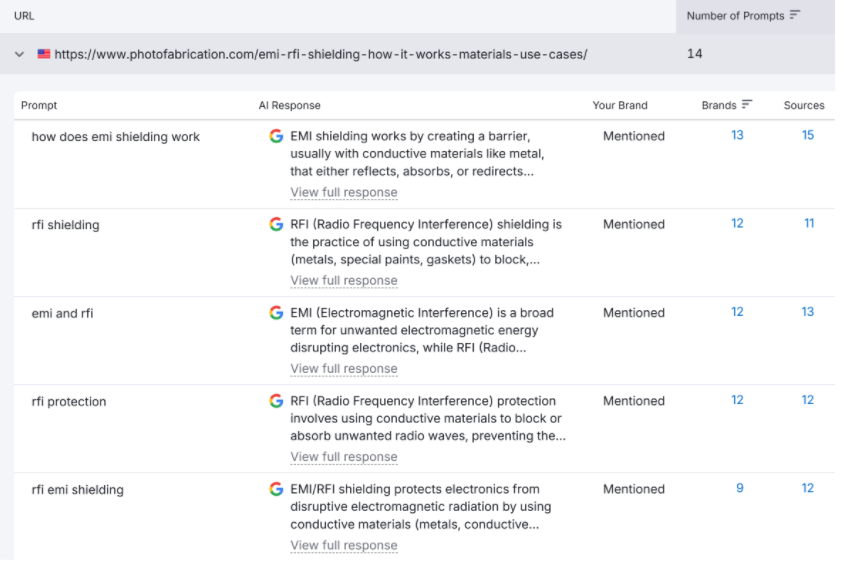
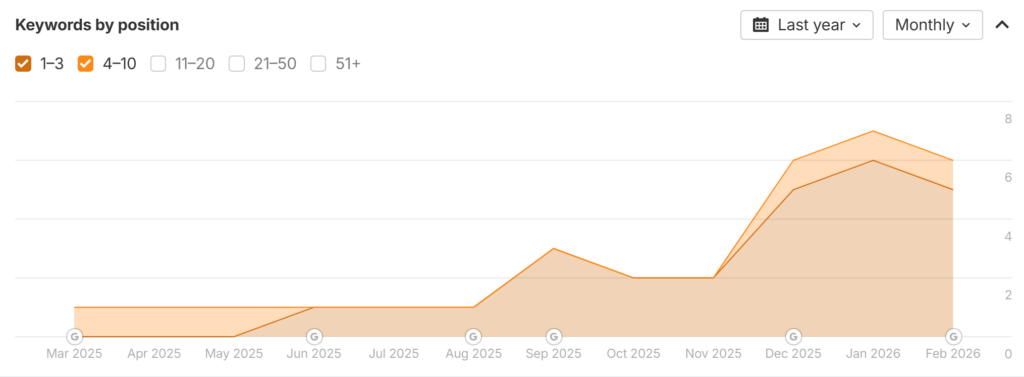
A good example of what this looks like in practice is a recent article we developed for a precision manufacturing client in the EMI/RFI shielding space.
Instead of treating the piece like a traffic asset built to win a single keyword, we treated it like a reference source. The kind of content that can be summarized, cited, and reused across search engines, AI tools, and discovery platforms.
In other words: content designed to travel.
Here’s what that looked like in practice.
Rather than opening with a brand pitch or burying definitions halfway down the page, the article clearly defined EMI, RFI, and shielding effectiveness up front – the same way an industry handbook would. That allowed AI tools and search engines to confidently explain the category using that content as a source.
The structure followed the questions buyers ask when researching the topic:
- “What is EMI/RFI shielding?”
- “How does it work?”
- “What materials are used?”
- “Where is it required?”
Because each section answered a complete question on its own, those sections could be summarized or referenced independently without requiring someone to read the full article or even visit the site.
We also avoided generic marketing language. Instead of positioning the brand with claims, the content demonstrated expertise through real-world applications, materials knowledge, and industry-specific context. That made it easier for AI systems and search features to infer credibility rather than ignore the page as promotional content.
We were also intentional about word association. The brand name was consistently placed alongside the core category terms it wanted to be known for (e.g., “{brand} is a leading provider of [X service]) in plain, factual sentences. Not repetitively, and not unnaturally, but often enough that the relationship between the company and the category was obvious.
That association matters because modern search and AI systems don’t just rank pages – they learn which brands belong to which topics. When a brand is repeatedly explained in context with a specific concept, it becomes part of how that category is understood and referenced.
The result wasn’t just rankings.
The article performs well in traditional search and shows up in AI-driven discovery environments where users are forming opinions, learning the category, and narrowing options long before they ever visit a website.
That’s Search Everywhere Optimization in practice.
Not a new channel.
Not a separate strategy.
Just SEO executed with the understanding that visibility now happens across more interfaces many of which don’t send clicks at all.
Why This Example Matters
This is the difference between writing for rankings and writing for influence.
When SEO is planned around how information actually travels – how it gets summarized, inferred, and trusted – content starts working earlier in the buying process and across more surfaces.
That’s how modern discovery works.
And that’s how SEO still does its job.
What Didn’t Change (Because It Still Works)
Technical SEO is still the prerequisite If AI can’t crawl or understand your site, none of the newer tactics matter. Visibility still starts with a technically sound foundation.
That means we continue to prioritize:
- Clean, logical site architecture
- Clear indexation and crawl control
- Page speed, accessibility, and performance
- Schema markup and structured data that make content easy to parse, ground, and attribute
Authority and trust still decide who gets surfaced AI systems don’t invent credibility, they borrow it. They rely on established entities and external signals to validate what information can be trusted.
That’s why we still focus on:
- Demonstrable, subject-matter expertise
- Consistent brand mentions across the web
- High-quality referring domains and reputable citations
If discovery happens everywhere, what does “doing SEO well” actually look like now?
The answer isn’t chasing every new acronym or optimizing for one shiny interface at a time.
It’s being intentional about how information is created, structured, and reinforced so it can travel (accurately and credibly) across search engines, AI systems, and the platforms people trust.
That’s where our approach evolved.
- Planning: Start With Visibility, Not Just Keywords
- Content planning used to begin and end with keyword research. That’s no longer enough.
Now, we analyze:
- What content ranks well in search engine results AND
- What content is most frequently cited, summarized, or referenced across AI tools and discovery platforms
- 2. Execution: Create Content That Can Travel
Once a topic is selected, execution is about clarity and reinforcement.
That means:
- Reiterating key industry terms alongside the brand name to build strong associations
- Defining concepts clearly, with context and examples, rather than assuming prior knowledge
- Structuring content so it’s easy to scan, summarize, and reuse – short sections, clear headings, tables when helpful
- 3. Post-Analysis: Measure Visibility, Not Just Clicks
Traffic still matters, but it’s no longer the whole story.
Post-launch, we look beyond sessions and rankings to evaluate:
- Whether content is being cited or referenced in AI-generated answers
- How often the brand appears in summaries, comparisons, or recommendations
- Whether visibility is influencing awareness and consideration earlier in the buying process
SEO didn’t split into GEO and AEO – it expanded. The goal is still visibility. The difference is where and how that visibility shows up.
SEO Is Still SEO… the “E” Just Stands for Everywhere
No new acronyms are required.
No panic is necessary.
SEO evolved to match user behavior.
Search Everywhere Optimization reflects reality.
As long as people seek information before making decisions, search optimization will matter.
At Farinella, we help teams understand where their brand shows up across search, AI, and discovery platforms and where it doesn’t. If you want a clearer picture of your current visibility, let’s start there.