






How Brand Clarity Saves Your Bottom Line
Our own David Farinella contributed an article to Forbes Agency Council titled “How Brand Clarity Saves Your Bottom Line.”
The article is based on decades of branding experience and on helping clients resolve brand confusion to grow the bottom line. Forbes gates the length of its content, so here is the full piece:
Clarify Your Brand Before Optimizing for AI
There’s a conversation happening in every marketing department right now.
It usually starts with someone asking why the company isn’t showing up in ChatGPT. Or why a competitor was named in an AI-generated response, and they didn’t. Or why all this content they’ve been producing isn’t translating into the kind of brand visibility everyone promised AI search would deliver.
The answer is almost never a technical one.
It’s a brand one.
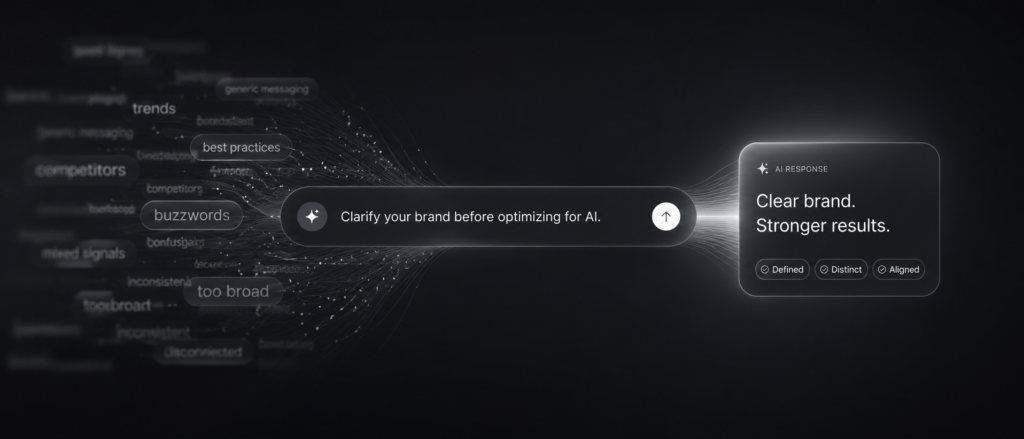
Before you worry about AI search optimization, you need to clarify your brand positioning. AI models, AI platforms, and AI-powered search engines rely on signals from across the web to understand what a company does, who it serves, and whether it belongs in a recommendation. If those signals are inconsistent, your visibility in AI gets weaker before the optimization work even starts.
Here’s what we’ve learned after three decades of helping businesses get found and get chosen: you cannot optimize your way out of a messaging problem. Not on Google. Not on social media. And especially not in the world of LLM-driven search.
If your brand voice is inconsistent, your positioning is vague, or your messaging sounds like everyone else in your category, no algorithm, artificial or otherwise, is going to save you.



What AI Models Are Actually Doing
To understand why brand architecture and messaging matter so much right now, you need to understand how large language models work — at least at a basic level.
LLMs don’t index your website the way Google does. They’re not scanning your meta descriptions or counting your backlinks in real time. They’ve been trained on vast amounts of content from across the web, and they’ve developed an understanding of categories, companies, and concepts based on how consistently and clearly those things have been described across multiple sources.
When someone asks an AI tool to recommend vendors in your category, the model draws on everything it absorbed during training — your website, yes, but also your LinkedIn page, industry publications that mentioned you, forum discussions, third-party reviews, press coverage, and anywhere else your brand has left a footprint.
Here’s the critical part: if all of those sources say something slightly different about who you are and what you do, the model doesn’t have a clear picture to work with. And a model that doesn’t have a clear picture of your brand is far less likely to confidently surface it when a buyer asks exactly the right question.
Consistency isn’t just a brand nicety anymore. It’s infrastructure.
The Positioning Problem:
Why Brand Positioning in AI Search Starts Before Optimization
Let’s be direct about something.
Most businesses don’t have a positioning problem because they haven’t thought about their brand. They have a positioning problem because they’ve thought about it in isolation — a website refresh here, a new tagline there, a LinkedIn bio that doesn’t quite match either.
The result is a brand that means different things in different places. And in an LLM-driven world, that ambiguity is expensive.
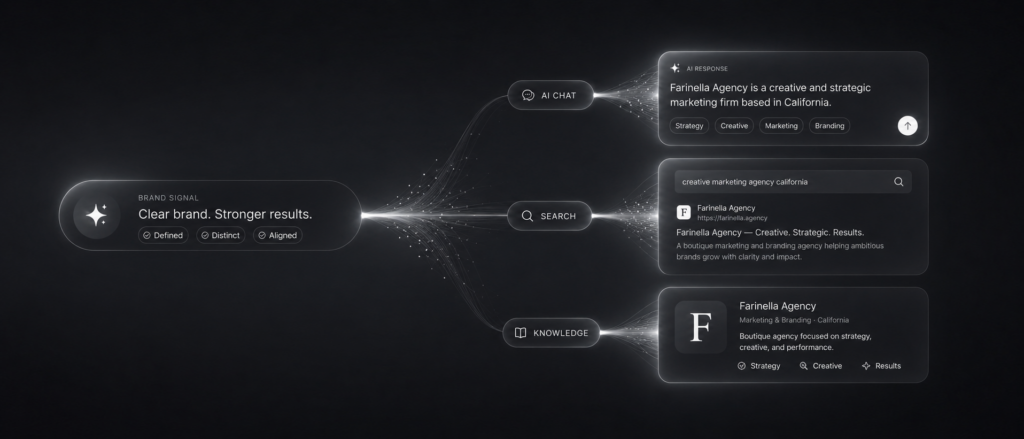
Think about what strong brand positioning in AI search looks like. It looks the same everywhere. The company name, the category it competes in, the problems it solves, the customers it serves, the language it uses to describe its expertise – all of it is consistent whether you’re reading the homepage, a trade publication feature, a Google Business Profile, a third-party review, or a Reddit thread where someone mentioned the company in passing.
That consistency creates signal. And signal is what gets you surfaced.
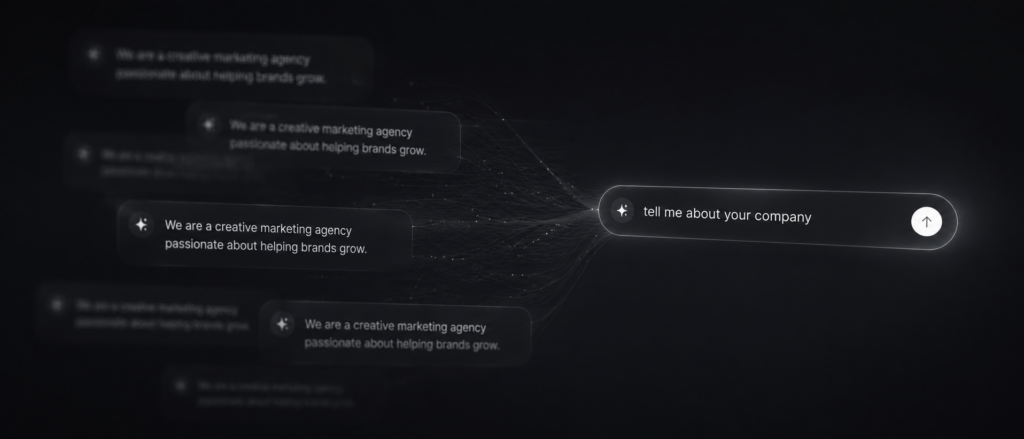
Now think about what a poorly architected brand looks like. The website says one thing. The LinkedIn page says something slightly different. The third-party directory listing is three years old and describes a service mix that no longer exists. The press release from two years ago uses language the company has since abandoned.
To a human, this is mildly confusing. To an LLM synthesizing all of these sources simultaneously, it’s noise. And noise gets filtered out.
AI Search Engines Look Beyond Your Website
Your website matters.
But it is not the whole story.
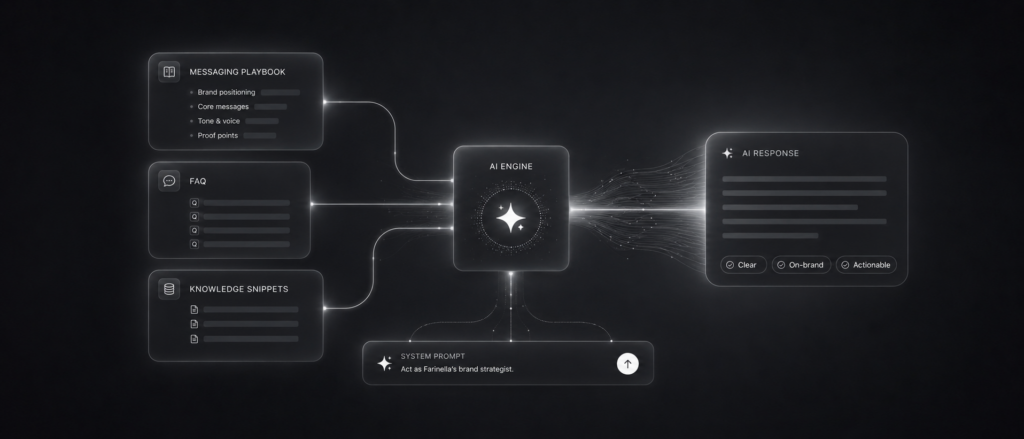
One of the biggest differences between traditional search engines and AI search engines is the way AI-generated responses are shaped by multiple sources at once. Your owned content may explain what you want the market to believe. Third-party sources help confirm whether the market believes it.
That distinction matters.
AI platforms are not just looking for what you say about yourself. They are also looking at what others say about you. Brand mentions, industry citations, press coverage, reviews, customer conversations, comparison pages, directory listings, podcast appearances, and user-generated content all contribute to the broader picture.
This is where brand sentiment starts to matter.
If the market consistently describes your company as a trusted brand strategy partner, that reinforces your positioning. If the market describes you inconsistently (or barely describes you at all) – AI models have less to work with.
User-generated content can play a role here, too. Reviews, forum discussions, social comments, and peer recommendations can act as organic proof of a brand’s performance, reputation, and intent. Not every mention carries the same weight. But taken together, those signals can.
Why Messaging Architecture Is the Foundation
Brand architecture isn’t just about the hierarchy of your products and services. It’s about building a messaging system that travels.
In the eBook we published on Search Everywhere Optimization, we make the case that the best content isn’t written to rank — it’s written to travel. The same principle applies to your brand messaging at every level.
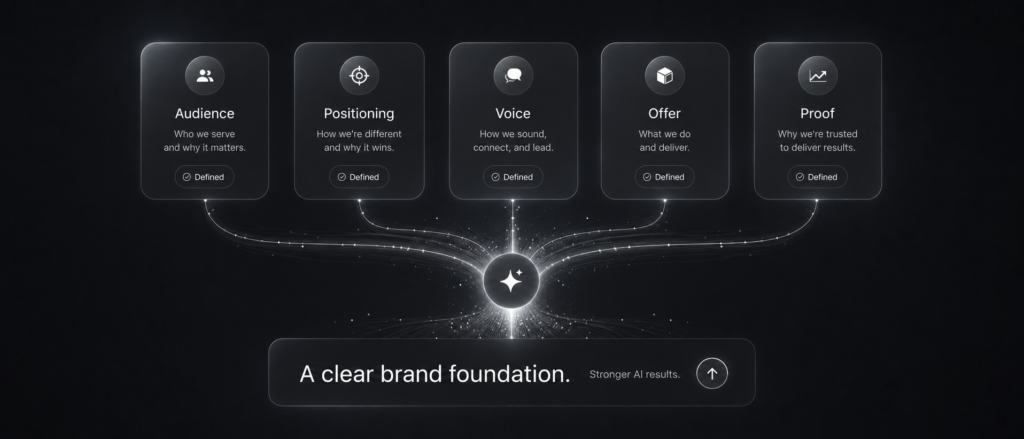
Your core positioning statement needs to be clear enough that someone who encountered it for the first time — human or machine — would immediately understand which category you compete in, who you serve, and why you’re credible.
Your supporting messages need to reinforce that positioning, not contradict it. Every differentiator, every proof point, every description of your process or approach should be pulling in the same direction.
And your language needs to be consistent. Not robotic. Consistent. There’s a difference between sounding like a template and sounding like yourself — clearly, distinctly, recognizably yourself — across every surface where your brand appears.
That’s what messaging architecture delivers. Not a tagline. Not a style guide that lives in a shared folder no one opens. A system for saying who you are in a way that sticks, travels, and builds over time.
The LLM Test
Here’s a simple exercise worth doing right now.
Open ChatGPT, Perplexity, and Google Gemini. In each one, ask: “Who are the leading [your category] companies for [your target customer]?”
Then ask: “What do you know about [your company name]?”
What you get back will tell you a lot. Not just whether you appear — but how you’re described. Is the language consistent with how you describe yourself? Does the AI capture your positioning accurately, or does it reduce you to a generic description that could apply to any competitor?
If the AI’s description of your company sounds nothing like your own, that’s a signal. It means the sources the model was trained on weren’t clear, consistent, or authoritative enough to give it an accurate picture.
That’s a messaging problem. And it’s fixable.
What Getting It Right Looks Like
When brand architecture and messaging are done well, a few things happen.
First, your own team gets clearer. One of the underrated benefits of rigorous messaging work is internal alignment. When everyone — from the CEO to the newest salesperson to the agency partner writing your content — is working from the same messaging framework, the brand starts to sound like itself across every touchpoint. That consistency compounds over time.
Second, your content gets better. When you know exactly what you stand for and how to say it, content creation stops being a guessing game. You’re not asking “what should we write about?” You’re asking, “How do we express this aspect of our expertise in a way that serves our buyers?” That’s a much more productive question.
Third, your external footprint gets stronger. Press coverage, guest contributions, industry mentions, third-party reviews — all of it starts to reinforce the same picture of who you are. And that picture is exactly what LLMs draw from when they decide whether your brand is worth surfacing.
Fourth — and this is the one that surprises people — your sales conversations get easier. When a prospect has encountered your brand in multiple places and heard the same clear, consistent story each time, they arrive already convinced of your credibility. The sales team isn’t educating from scratch. They’re confirming what the buyer already believes.
That’s what strong brand architecture does. It does the work before the conversation starts.
The Bottom Line
Everyone wants to know how to show up in AI search. It’s a legitimate question, and the answer involves content strategy, technical foundations, external presence, and consistent measurement.
But all of that sits on top of something more fundamental.
If your brand doesn’t know what it stands for — or knows but can’t say it clearly and consistently everywhere it shows up — LLM optimization is building on sand.
Get the foundation right first. Define your architecture. Build your messaging system. Make sure your brand sounds like itself, whether someone finds you on Google, in a ChatGPT answer, on LinkedIn, or in a peer recommendation at an industry conference.
Then optimize.
The brands that will win in the Search Everywhere landscape aren’t the ones who figured out the latest algorithm trick. They’re the ones who were clear, consistent, and credible long before anyone was asking AI tools for recommendations.
That work starts with brand.